
🛠️ Helper Tools
SounderPy includes several helper functions for profile calculations,
interpolation, file export, station lookup, and manipulation of clean_data
profiles.
See clean_data schema for the common profile structure used by these tools.
Returning a dictionary of profile parameters
Calculate SounderPy’s thermodynamic, kinematic, and interpolated profile parameters for a given clean_data profile.
The calculation returns a dictionary with four dictionaries inside it:
general: general profile information and derived quantities;thermo: thermodynamic parameters;kinem: kinematic parameters; andintrp: an interpolated version of the profile.
- class sounding_params(
- clean_data,
- storm_motion='right_moving',
- modify_sfc=None,
- include_all_parcels=False,
- parcel_depth=None,
- Parameters:
clean_data (dict, required) – the dictionary of profile data to calculate profile parameters for (see 🌐 Tools for Getting Data)
storm_motion (str or list of floats, optional) – the storm motion used for calculations. Default is ‘right_moving’. Custom storm motions are accepted as a
listoffloatsrepresenting direction and speed. Ex:[270.0, 25.0]where ‘270.0’ is the direction in degrees and ‘25.0’ is the speed in kts. See the Storm Motion Logic section for more details.modify_sfc (None or dict, optional, default is None) – a
dictin the format{'T': 25, 'Td': 21, 'ws': 20, 'wd': 270}to modify the surface values of theclean_datadict.include_all_parcels (bool, optional, default is
False) – whether to lift a parcel from every level of the profile, which adds CAPE, CIN, and 3CAPE profiles (cape_profile,cin_profile, and3cape_profile) tothermo. This is slower.parcel_depth (int or float, optional, default is
None, which lifts a parcel from every level) – withinclude_all_parcels, only lift parcels from levels up to this height (m AGL). Levels above it arenan. This is much faster when only the lowest few kilometers are needed.
- .calc()
- Returns:
A dictionary with the keys
general,thermo,kinem, andintrp, each holding a dictionary of profile data.- Return type:
dict
Example:
params = spy.sounding_params(clean_data).calc()

params['thermo']['mlcape']
params['kinem']['srh_0_to_1000']
Changed in version 3.3.0: .calc() returns a dictionary. It used to return a tuple, which was unpacked with general, thermo, kinem, intrp = spy.sounding_params(clean_data).calc().
Note
These calculated parameters are the same used on SounderPy plots. This function simply returns the master dictionary of all of these values.
Returning a dictionary of winter parameters
Calculate everything sounding_params does, plus a fifth dictionary, winter, with the values behind the winter sounding (build_sounding(mode='winter')):
precipitation type: Bourgouin’s method (
ptype) and SHARPpy’s best guess (sharppy_ptype), the precipitation source level, and the phase of falling precipitation from the source to the surface (phase_trace);melting and refreezing layers and their energies (
layers), freezing levels, and the warm nose;cloud and icing layers;
snow growth: the dendritic growth zone in cloud (
dgz_z,dgz_p,dgz_depth), its RH and omega, OPRH, and the snow-to-liquid ratio (slr);the PBL (SHARPpy’s
pbl_top): depth, lapse rate, and mean wind (pbl_depth,pbl_lapse_rate,mean_wind_pbl; also inthermoandkinem);surface and hazard values: wind chill, PBL max gust, the snow squall parameter, surface inversion, and freezing fog and freezing drizzle potential (
fzfg,fzdz);winds: 10 m, PBL and DGZ mean winds, the 0-2 km max wind, and the winds at 850, 700, and 500 hPa.
- class winter_params(
- clean_data,
- storm_motion='right_moving',
- modify_sfc=None,
- include_all_parcels=False,
- parcel_depth=None,
- Parameters:
clean_data (dict, required) – the dictionary of profile data to calculate profile parameters for (see 🌐 Tools for Getting Data)
storm_motion (str or list of floats, optional) – the storm motion used for calculations, as in
sounding_params.modify_sfc (None or dict, optional, default is None) – a
dictin the format{'T': -2, 'Td': -3, 'ws': 20, 'wd': 20}to modify the surface values of theclean_datadict. The modified surface is used for both the standard and the winter values.include_all_parcels (bool, optional, default is
False) – as insounding_params.parcel_depth (int or float, optional, default is
None) – as insounding_params.
- .calc()
- Returns:
A dictionary with the keys
general,thermo,kinem,intrp, andwinter, each holding a dictionary of profile data.- Return type:
dict
Example:
params = spy.winter_params(clean_data).calc()

params['winter']['ptype']        # e.g. 'FZRA'
params['winter']['dgz_depth']    # m
params['thermo']['mlcape']       # every sounding_params value is here too
Added in version 3.3.0.
Note
These are the values drawn on the winter sounding. Values that can’t be calculated for a profile, such as omega values for data without omega (RAOBs), are masked.
Saving data to a file
- spy.to_file(file_type, clean_data, filename=None, convert_to_AGL=True)
Create a file of ‘cleaned’ SounderPy data
- Parameters:
file_type (str, required) – a
strrepresenting the file type you’d like to export data to.clean_data (dict, required) – ‘cleaned’ SounderPy data
dictfilename (str, optional, default is
None) – output filename. If omitted, SounderPy uses its defaultoutput filename.convert_to_AGL (bool, optional, default is
True) – whether or not to convert height values to “above ground level” when saving to a file. Useful for CM1.
- Returns:
a file of SounderPy data.
Example:
Supported
file_typevalues are:"csv""sharppy""cm1"
spy.to_file("csv", clean_data, filename="sounding.csv")

spy.to_file("sharppy", clean_data, filename="sounding.snd")

spy.to_file("cm1", clean_data, filename="input_sounding")
See 💾 Exporting Data for complete export examples.
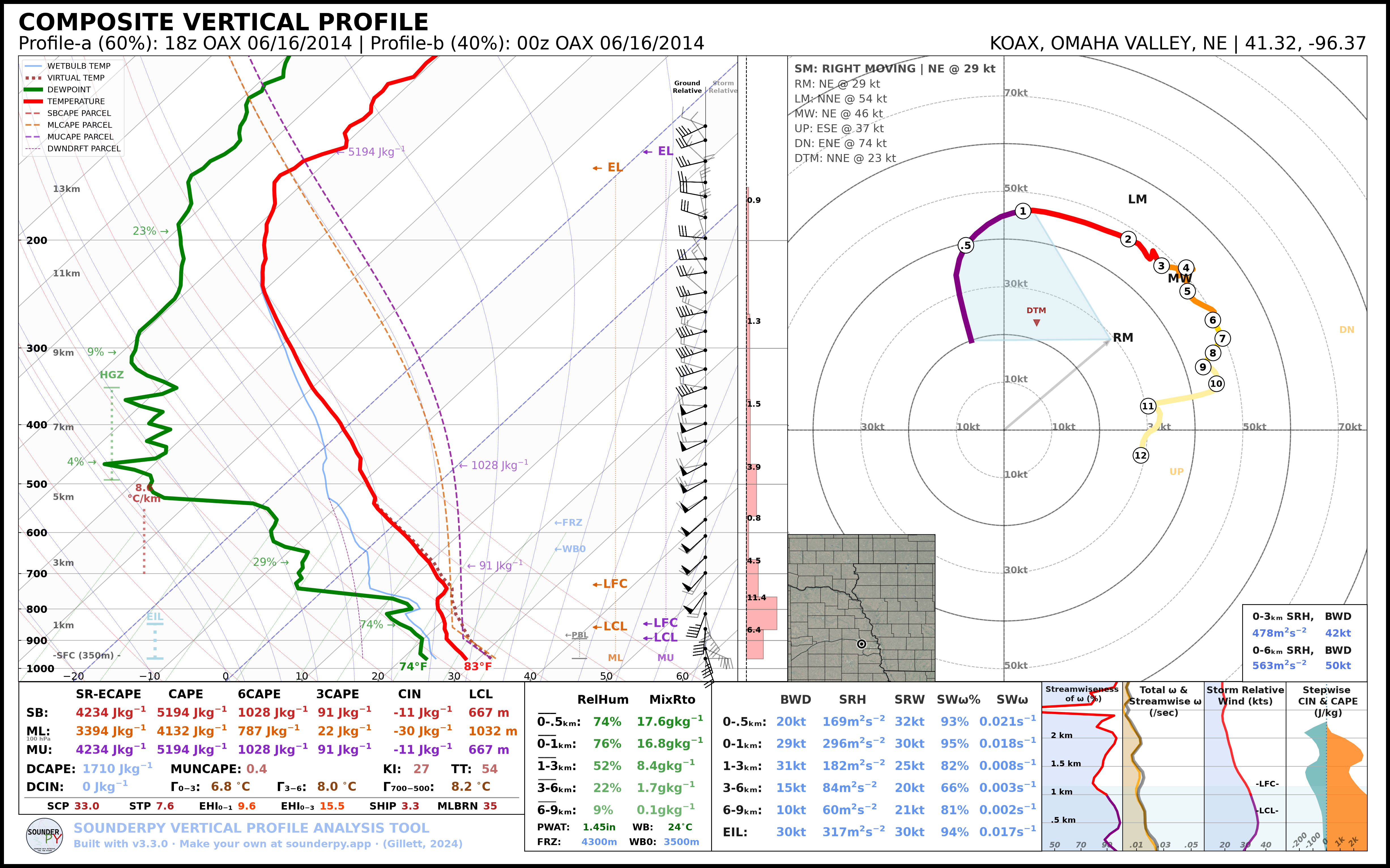
Merging two profiles via weighted averaging
Merge two profiles together using weighted averaging of values along a common height axis to return a single profile.
- spy.merge_profiles(profile_a, profile_b, weight_a)
- Parameters:
profile_a (dict, required) – a SounderPy
clean_datadictionary containing variable arrays for profile_a.profile_b (dict, required) – a SounderPy
clean_datadictionary containing variable arrays for profile_b.weight_a (float, optional) – the weight for
profile_ain the averaging scheme, default is 0.5 (50%)
- Returns:
a
clean_datadictionary with weighted-averaged values for z, T, Td, u, v, and p without metadata (see example below)- Return type:
dict
Example:
# load in some sounding data
profile_a = spy.get_obs_data("OAX", "2014", "06", "16", "18")
profile_b = spy.get_obs_data("OAX", "2014", "06", "17", "00")

# apply `merge_profiles()` function
merged_profile = spy.merge_profiles(profile_a, profile_b, weight_a=0.6)

# reapply profile metadata and plot titles
merged_profile['site_info'] = {'site-id': 'KOAX',
                          'site-name': 'OMAHA VALLEY',
                          'site-lctn': 'NE US',
                          'site-latlon': [41.32, -96.37],
                          'site-elv': 350,
                          'source': 'RAOB OBSERVED PROFILE',
                          'model': 'none',
                          'fcst-hour': 'none',
                          'run-time': 'none',
                          'valid-time': 'none',
                          'box_area': 'none'}
merged_profile['titles'] =  {'top_title':   'COMPOSITE VERTICAL PROFILE',
                          'left_title':  'Profile-a (60%): 18z OAX 06/16/2014 | Profile-b (40%): 00z OAX 06/16/2014',
                          'right_title': 'KOAX, OMAHA VALLEY, NE | 41.32, -96.37    '}

# build a sounding
spy.build_sounding(merged_profile, radar=None, special_parcels='simple')
Important
merge_profiles() returns the merged profile variables but does not
automatically create new site_info or titles metadata. These should
be supplied before producing a fully annotated SounderPy plot.
Smooth a profile
Apply a simple SciPy gaussian smoother to a SounderPy clean_data profile
- spy.smooth_profile(clean_data, sigma)
- Parameters:
clean_data (dict, required) – a SounderPy
clean_datadictionary.sigma (float, optional, default is
0.5) – standard deviation of the Gaussian kernel. Larger values produce stronger smoothing.
- Returns:
a
clean_datadictionary with smoothed values for z, T, Td, u, v, and p. Metadata remains unchanged.- Return type:
dict
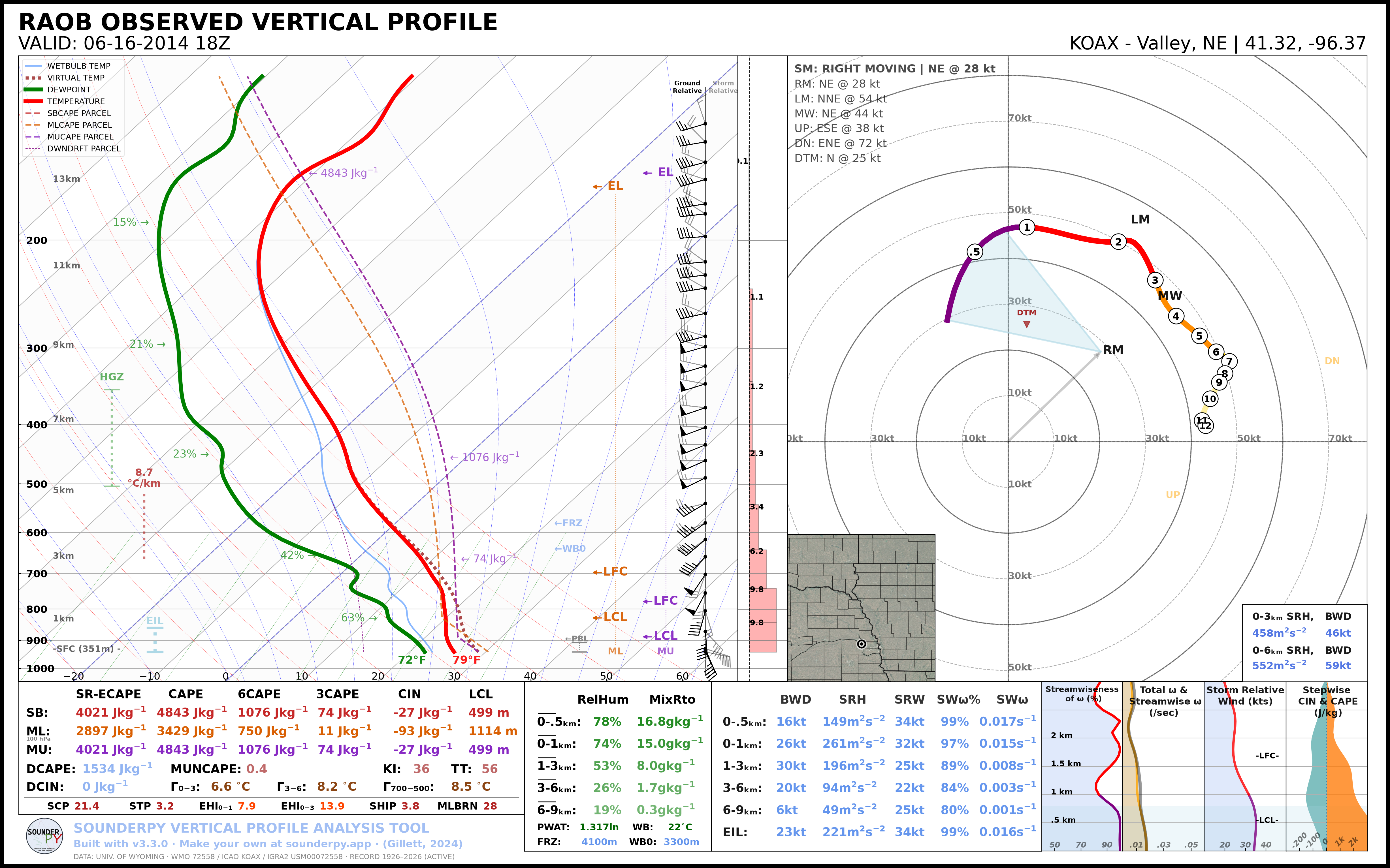
Here is an (extreme) example:
# load in some sounding data
clean_data = spy.get_obs_data("OAX", "2014", "06", "16", "18")

smoothed_profile = spy.smooth_profile(clean_data, 3)
spy.build_sounding(smoothed_profile, radar=None, special_parcels='simple')
Note
Smoothing alters the original observed or modeled profile. Use this tool carefully when calculating quantities that depend on sharp vertical gradients, such as lapse rates, inversions, shear, or parcel properties.
Finding a station latitude/longitude
- spy.get_latlon(station_type, station_id)
Return the latitude and longitude associated with a supported station identifier.
- Parameters:
station_type (str, required) – the station ‘type’ that corresponds with the given station ID
station_id (str, required) – the station ID for the given station type
- Returns:
lat/lon float pair
- Return type:
list
Example:
spy.get_latlon("metar", "KMOP")
spy.get_latlon("bufkit", "APX")
spy.get_latlon("raob", "OUN")
spy.get_latlon("buoy", "45210")
Tip
The returned [latitude, longitude] list can be passed directly to
get_model_data.
Interpolating a vertical profile
- spy.interp_data(variable, heights, step=100)
Interpolate a 1D array of data (such as a temperature profile) over a given interval (step) based on a corresponding array of height values.
- Parameters:
variable (array-like, required) – an array of data to be interpolated. Must be same length as height array.
heights (array-like, required) – heights corresponding to the vertical profile used to interpolate. Must be same length as variable array.
step (int, optional) – the resolution of interpolation. Default is 100 (recommended value is 100)
- Returns:
interp_var, an array of interpolated data.
- Return type:
numpy.ndarray
Example:
spy.interp_data(temperature_array, height_array, step=100)
Finding a ‘nearest’ value
- spy.find_nearest(array, value)
Return the index of the array element closest to a requested value.
- Parameters:
array (arr, required) – an array of data to be searched through
value (int or float, required) – Target value to locate within the array.
- Returns:
nearest_idx, index of the data array that corresponds with the nearest value to the given value
- Return type:
int
Example:
idx_500m = spy.find_nearest(z, 500)

print(z[idx_500m])
Printing data to the console
Print a compact summary of commonly used thermodynamic and kinematic parameters to the console.
- spy.print_variables(clean_data)
- Parameters:
clean_data (dict, required) – the dictionary of profile data to calculate profile parameters for (see 🌐 Tools for Getting Data)
- Returns:
None. Calculated parameters, using the right-moving storm motion, are written to standard output.- Return type:
None
spy.print_variables(clean_data)
> THERMODYNAMICS ---------------------------------------------
--- SBCAPE: 2090.8 | MUCAPE: 2090.8 | MLCAPE: 1878.3 | MUECAPE: 1651.9
--- MU 0-3: 71.1 | MU 0-6: 533.0 | SB 0-3: 71.1 | SB 0-6: 533.0

> KINEMATICS -------------------------------------------------
--- 0-500 SRW: 35.0 knot | 0-500 SWV: 0.019 | 0-500 SHEAR: 21.8 | 0-500 SRH: 186.2
--- 1-3km SRW: 20.9 knot | 1-3km SWV: 0.005 | 1-3km SHEAR: 14.1 | | 1-3km SRH: 54.0